

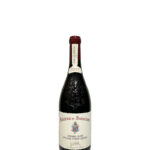
Châteauneuf-du-Pape 2007, Château de Beaucastel
Château de Beaucastel: Where the History of Wine Really Begins
Some estates have history. And then there is Château de Beaucastel — a place where history is literally beneath your feet, buried in the famous galets roulés of the Châteauneuf-du-Pape appellation, deposited there by the Rhône river across millennia.
The year is 1549. Europe is in the midst of the Renaissance. Michelangelo is still alive. And the Perrin family lays the first stone of what will become one of the world’s greatest wine estates. Five centuries later, four generations deep, brothers Marc, Thomas, Pierre and Mathieu Perrin are doing exactly what their ancestors always did: listening to the land.
The Terroir: A Geology Lesson in One Sip
To understand Beaucastel, you must first understand its soil. The famous galets roulés — those fist-sized, river-polished stones — blanket the surface like a natural battery. During the day, they absorb the heat of the Provençal sun. At night, they release it slowly back to the vines, like a stone hot water bottle. The result? A ripeness that comes from within, not forced by the sun.
Beneath: sand, clay, limestone. Deep enough that the roots of the old vines — some over 80 years old — must dig into the earth’s interior to find water and minerals. That struggle is not a weakness. It is the soul of the wine.
The Philosophy: 13 Grape Varieties, One Vision
In a world where winemakers increasingly specialise in one or two grape varieties, Beaucastel does the opposite. All 13 varieties permitted by the appellation are cultivated here — organically farmed since the 1960s, long before organic became a trend. Grenache and Mourvèdre form the backbone, but it is the quiet supporting cast — Counoise, Vaccarèse, Muscardin — that give the wine its inimitable complexity.
Marc Perrin puts it this way: a single-variety wine is a monologue. Beaucastel is a chorus.
Mourvèdre: The Secret Weapon
While most Châteauneuf-du-Pape producers treat Grenache as their undisputed king, Beaucastel has always given Mourvèdre an extraordinary role — up to 30% of the blend. This decision is radical and polarising. Mourvèdre is demanding: it ripens late, needs heat, gives little away. But when it works, it delivers something no other grape can: that dark, meaty, almost animal depth that sets a Beaucastel apart from everything else. Truffle. Leather. Earth after rain. That is Mourvèdre. That is Beaucastel.
A Wine That Waits — and Rewards
Beaucastel is not a wine for the impatient. In its youth it can seem closed, almost sullen. But those who wait — truly wait — will be rewarded with something that has become rare in modern winemaking: genuine maturity. Genuine complexity. A wine that does not merely taste, but tells a story.
The 2007 is the perfect illustration. After nearly two decades, it has reached exactly the point Robert Parker predicted: complete harmony, explosive on the nose, silky on the palate, with a finish that refuses to end.
Some wines are drunk. Beaucastel is experienced.
Reviews
There are no reviews yet.