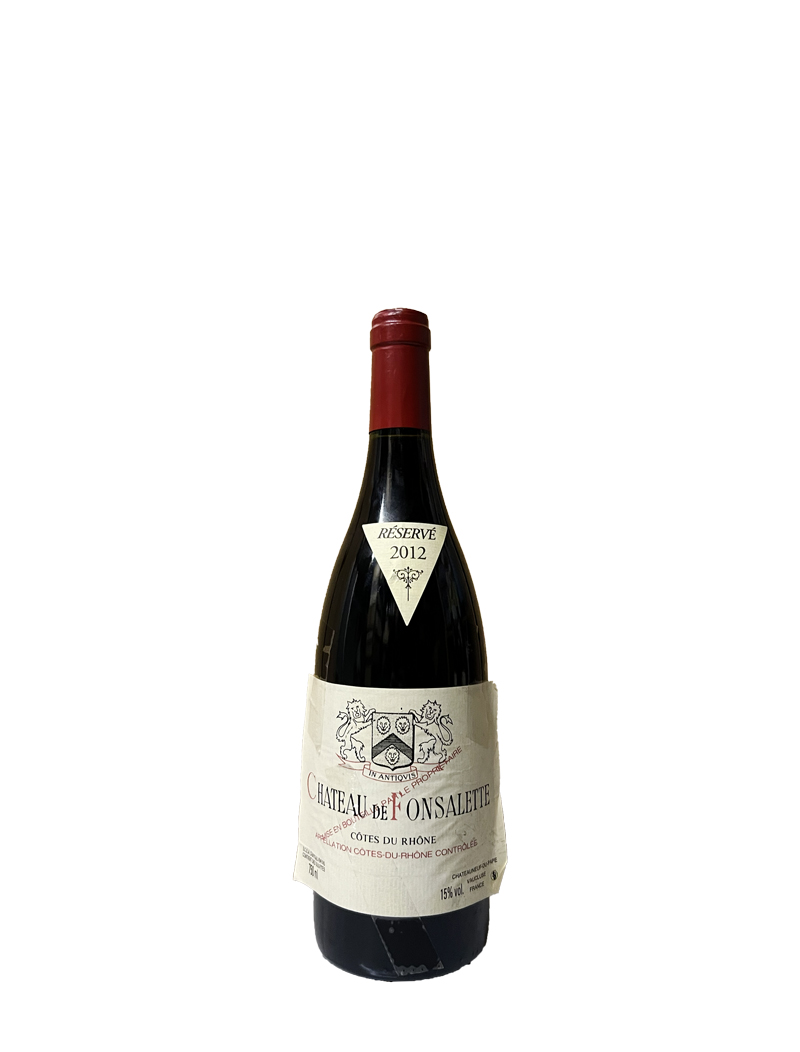
Côtes du Rhône Rouge 2012, Château de Fonsalette
Château de Fonsalette: The Secret on the Other Side of the Boundary
Boundaries in wine are strange things. One metre of difference in location can be the difference between a simple table wine and a legendary Grand Cru — not because of the soil, not because of the grape, but because of a line that humans drew on a map.
Château de Fonsalette lives on the wrong side of that line. And makes of it one of the greatest estates in France.
1945: The Purchase That Started Everything
Louis Reynaud, grandfather of the current guardian Emmanuel Reynaud, acquired Fonsalette in 1945 — shortly after the end of the Second World War, in a France slowly rebuilding itself. The estate lies near Lagarde-Paréol, in the Côtes du Rhône area, directly at the northern edge of the Châteauneuf-du-Pape appellation. 120 hectares in total: forests, olive groves, agricultural land — and just 12 hectares of vines. This modesty of surface is not a weakness. It is intention.
The soils are complex: sand, clay, limestone — similar but not identical to the famous gravel soils of Rayas. Old-vine Grenache, Cinsault and Syrah for the reds; Grenache Blanc, Clairette and Marsanne for the whites. All harvested by hand. All vinified with the same methods as Rayas. All aged in the same cellar.
One Cellar. Three Legends.
This is the key to understanding Fonsalette: the wine is not vinified at Fonsalette itself. It travels to Emmanuel Reynaud — to Château Rayas. There, in the same mythical cellar, under the same direction, with the same old foudres and the same philosophy, the Fonsalette Rouge is born alongside the Rayas, alongside the Pignan. No temperature control. No filtration. Spontaneous fermentation. Long ageing.
What distinguishes Fonsalette from Rayas is not the method. It is the terroir — the other side of the boundary. And that makes it one of the most fascinating wines in France: a wine one does not drink because it is cheaper than Rayas. One drinks it because it is different. More deeply rooted in Cinsault and its floral lightness. Broader in its Grenache base. More accessible, but no less complex.
Cinsault: The Forgotten Pearl
In a world that worships Grenache and Syrah, Cinsault is the forgotten grape. Too light, some say. Too little colour, too little extraction. And yet: in Fonsalette, the Cinsault — up to 35% of the blend — gives the wine something Grenache alone cannot provide. Flowers. Rose. Violet. An airy lightness that keeps the wine from ever feeling heavy despite its depth. It is this lightness that distinguishes Fonsalette from every other southern Rhône wine — that Burgundian bearing that runs through every vintage.
The Price of Integrity
Fonsalette is one of the most sought-after Côtes du Rhône in the world — and one of the most expensive. Bottles from the great vintages change hands for more than 500 CHF on the secondary market. Not because there was a plan to create a luxury Côtes du Rhône. But because Emmanuel Reynaud simply does the only thing he knows: wine of absolute integrity, regardless of what is written on the label.
That is the paradox of Fonsalette. The label says Côtes du Rhône. The wine says: I am what I am. And that is enough.

Reviews
There are no reviews yet.