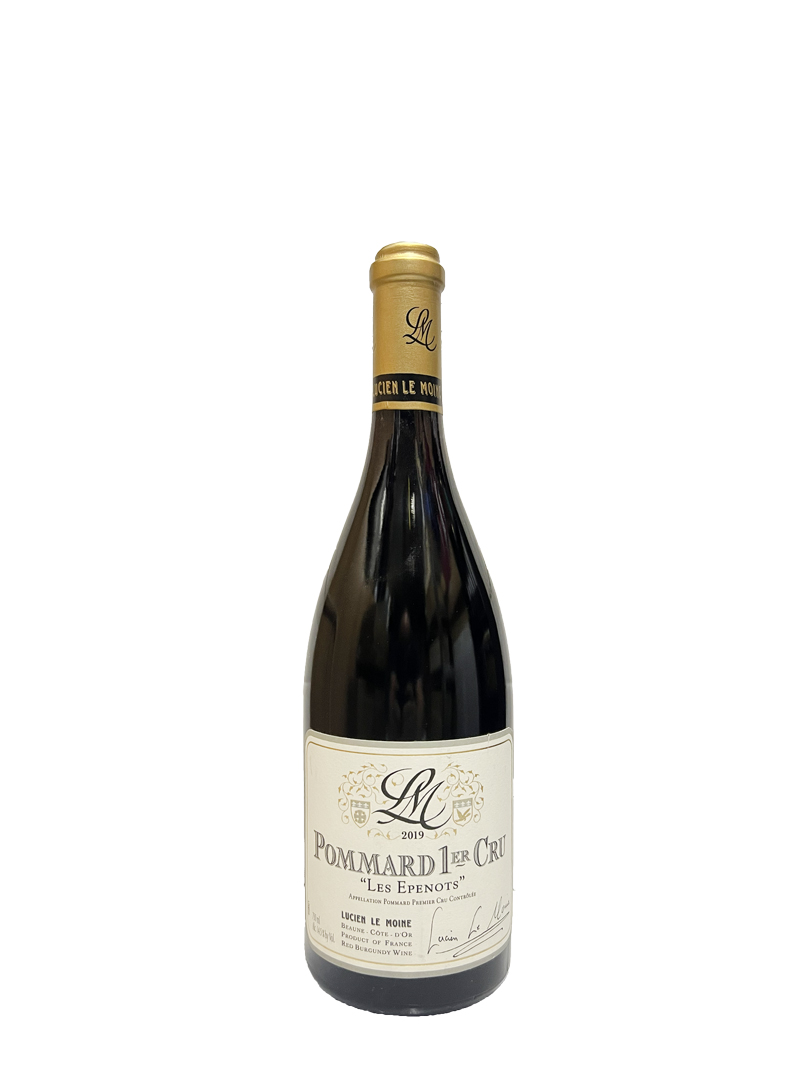
Pommard 1er Cru Les Épenots 2019, Lucien Le Moine
Lucien Le Moine: A Monk, a Cellar, an Obsession
There are houses in Burgundy with centuries of history. And then there is Lucien Le Moine — founded in 1999 by a Lebanese man who learned to make wine in a monastery in the Middle East. A story you could not invent.
Mounir Saouma grew up in a farming family in Lebanon. In the late 1980s, he visited a Trappist monastery in the Middle East — and stayed. Not for a week. For a long time. He worked in the monastery vineyards, learned to vinify, to ferment, to understand what wine truly is. It was not a training course. It was a calling.
The Name: A Double Bow
“Lucien Le Moine” is not a name chosen by chance. It is a carefully crafted tribute: Mounir means “light” in Arabic — the French equivalent is Lucien. Le Moine means “the monk” — a nod to the years in the monastery that started everything. The name therefore literally means: “The Enlightened Monk.” One could not be more precise.
The Concept: Haute Couture in Barrel Form
After the monastery, Mounir studied oenology in Montpellier, then spent six years working in Burgundy, other French regions and California. In 1999, together with his wife Rotem Brakin — an agronomist from a cheesemaking family and prize-winner of the French Academy of Agriculture — he founded a small négociant house in Beaune.
The philosophy: never more than 100 barrels per year. Exclusively Premier Cru and Grand Cru. Each climat vinified separately, often just a single barrel. Mounir describes his own dream as building “a library of the greatest terroirs of the Côte d’Or — every vintage.” Up to 75 different wines per vintage, some produced in quantities of just 300 bottles.
The Method: Patience as Philosophy
Lucien Le Moine is not a domaine in the classical sense. Mounir purchases wines after fermentation from selected growers — but the heart of his work lies in the cellar. He calls it “élevage”: the art of ageing. Extended time on the lees, no racking, no fining, no filtration. Sometimes up to 60 months in cool cellars, fermenting slowly and naturally, protected by the CO2 produced by the yeasts themselves.
His colleagues call him mad. His clients call him a genius.
Les Épenots: The Jewel of Pommard
The climat Les Épenots sits in the north-east of Pommard, directly bordering Beaune, in sight of the Grand Cru road. The soil is rich in clay and limestone marl — heavy, complex, deep. A parcel that even filed a request for reclassification to Grand Cru status in 2012. That says everything.
Les Épenots produces a Pommard that embodies both the heart of the appellation and its most elegant face. Powerful yes — but never coarse. Tannic yes — but never dry. It is the Pommard for people who do not usually like Pommard.
In Mounir Saouma’s hands, a great terroir becomes something singular. A wine you drink and understand: why a Lebanese man once stayed in a monastery — to learn exactly this.
Reviews
There are no reviews yet